
The Same-Day Edit That Nearly Died at 1%
Dixit Kamal — September 5, 2026
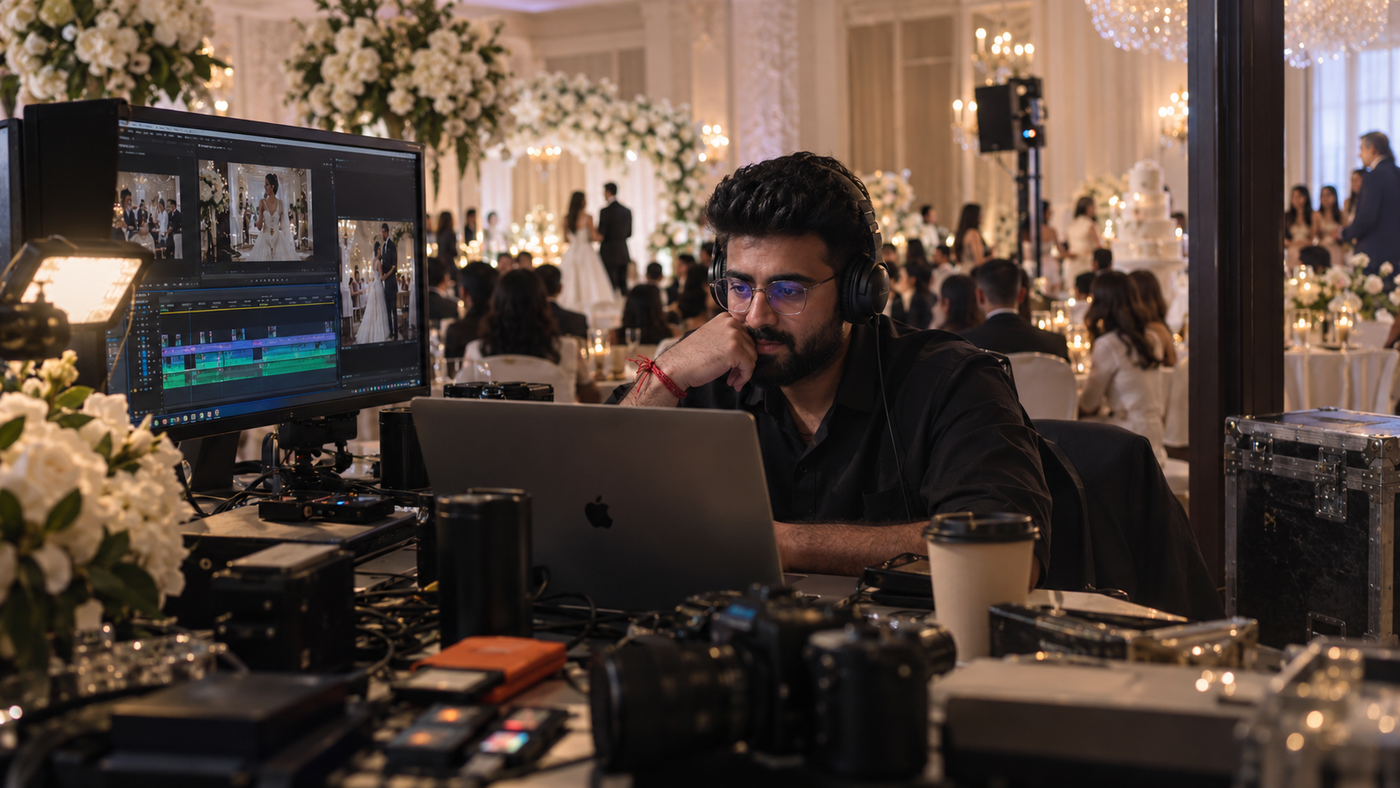
Phase One — 2:00 PM: The Clock Starts
At 2:00 PM, I opened the laptop, plugged in the drives and looked at the timeline. Empty. The wedding was already happening around me, but my job was to somehow turn the next five hours into a finished film. The deadline was 7:00 PM. That was the plan, anyway. I had the editing laptop, a few drives, cameras coming back with footage and just enough confidence to believe everything would go smoothly. That confidence lasted approximately ten minutes. The first problem was simple: I didn't have the right USB hub. Without it, transferring footage from multiple cards and drives was going to be painfully slow. A same-day edit is basically a race against time, and I had just discovered that someone had quietly removed one of the wheels from my car.
The next problem was worse. The laptop charger wasn't working properly. I unplugged it, plugged it back in, changed the socket, checked the connection again. Nothing. The battery percentage wasn't going up. It was going down. Slowly, almost politely, like the laptop was giving me a warning before eventually murdering the entire project. I looked at the battery. I looked at the clock. Then I looked at the wedding happening outside. This was no longer just an editing job. This was now a hostage situation, and my laptop was holding the ransom.
Phase Two — 2:45 PM: The Footage Starts Coming In
The first footage arrived, but not everything I needed was there. One card had footage from the bride's preparations. Another had some groom shots. Someone else had captured the venue. But the footage I was expecting wasn't coming through. I called the team. "Where's the ceremony footage?" Nobody had it yet. "Where's the drone?" Still shooting. "What about the bride's entrance?" That hadn't happened. This is the strange thing about editing a wedding while the wedding is still happening: you can't simply ask for the missing scene and wait until tomorrow. Tomorrow doesn't exist. If the footage doesn't arrive, there is no film. So I started building the story around what I had, knowing that the most important pieces were still somewhere out there, being recorded by people who had no idea that my timeline was slowly becoming a crime scene.
Then the storage problem became real. I didn't have the luxury of a huge, fast SSD sitting beside me with everything neatly organized. I was moving footage around, making space, deciding what actually needed to be transferred and what could wait. Every gigabyte mattered. Every transfer felt like watching paint dry while someone held a stopwatch over my head. I started creating a rough sequence from the footage I had, knowing full well that I would probably have to tear half of it apart when the missing shots arrived. The wedding photographer was shooting portraits. The cinematographers were still collecting footage. Guests were arriving. The music was getting louder. And I was sitting in the corner trying to build an emotional climax out of incomplete information.
Phase Three — 4:00 PM: Everything Starts Going Wrong
By 4:00 PM, I had enough footage to know what the film could become, but not enough footage to finish it. The charger still wasn't behaving. The battery was dropping. The USB hub situation still hadn't magically fixed itself. And then we realized we were missing footage that we absolutely needed. Not "nice to have" footage. Needed footage. The kind of shot you build an entire sequence around. I could feel the edit changing in my head. The original structure was gone. I started cutting differently, creating alternate sequences and leaving gaps where the missing footage would eventually go. It was like assembling a plane while it was already flying.
At some point, I stopped looking at the clock every few minutes because it was making things worse. Then I looked again. 5:00 PM was getting closer. The film was still incomplete. I had footage coming from different cameras, different cards and different people, and I was trying to keep the story coherent while simultaneously ingesting, organizing, selecting, editing, grading and listening for audio problems. There was no time to be precious. If a shot was good but didn't move the story forward, it was gone. If a sequence took too long to build, it was gone. I wasn't making the perfect film anymore. I was trying to make the best possible film before the clock made the decision for me.
Phase Four — 5:30 PM: The Deadline Moves
Then came the phone call nobody wants during a same-day edit: we weren't going to make 7:00 PM.
The final footage was still coming in. The edit needed more time. There was no point pretending otherwise. We pushed the screening to 7:30 PM. Thirty minutes. That's all we had bought ourselves. In any normal editing environment, thirty minutes is nothing. In a same-day edit, thirty minutes can be the difference between a finished film and a very expensive apology. I went back into the timeline and started cutting with almost no hesitation. The missing footage finally began arriving. I grabbed what I needed, dropped it into the sequence and rebuilt the ending. The emotional structure finally clicked. Bride. Groom. Family. Ceremony. Celebration. The story was suddenly there.
At around 6:30 PM, I was no longer editing individual clips. I was fighting for seconds. I tightened transitions. Removed unnecessary shots. Fixed audio. Adjusted colour. Replaced clips that didn't work. The laptop fan was screaming. My eyes were dry. The charger was still useless. The battery kept falling. Every time I looked at the percentage, it was lower. The film was almost finished, but the machine making the film was slowly running out of life. It felt absurd. After everything that had gone wrong that afternoon, the final boss was going to be a battery percentage.
Phase Five — 7:15 PM: 1%
At 7:15 PM, the film was exported—or at least I thought it was. I watched the file back quickly. Audio was there. Picture was there. No obvious glitches. I made one last correction, exported again and looked at the battery. 1%. One percent. The charger was still not charging. There was no backup laptop sitting beside me. There was no tomorrow. There was no "I'll send it later." The couple and their guests were waiting to see their wedding film that night. I had one percent battery and a file that had to survive long enough to be delivered.
At 7:30 PM, it was done. Somehow, after the missing footage, the useless USB hub situation, the storage nightmare, the broken charger, the disappearing battery and five hours of continuously changing footage, the film existed. I closed the laptop and looked at the timeline one last time. It wasn't the film I would have made with three days, unlimited storage, a proper editing station and every piece of footage perfectly organized. It was something else. It was a film made under pressure, built while the wedding itself was still unfolding.
And then the lights went down.
The couple watched their wedding on a screen while the actual wedding was still happening around them. They saw moments from earlier that afternoon, moments they had forgotten, moments they hadn't even seen. The room went quiet in the way rooms do when people suddenly recognize themselves on screen. For five hours, I had been thinking about drives, cards, missing footage, battery percentages and deadlines. Sitting there, watching their reaction, none of that mattered anymore.
That is the part people don't see when they watch a same-day edit.
They see a five-minute film.
They don't see the five hours behind it. They don't see the footage that never arrived, the storage that wasn't fast enough, the USB hub that wasn't there, the charger that refused to charge, the timeline that kept changing, or the laptop sitting at 1% while the deadline was already knocking on the door.
A same-day edit isn't just editing quickly.
It's making a film while the story is still happening.
And sometimes, you have to finish the story before the battery dies.