
The Wedding That Almost Broke Us: A Story
Dixit Kamal — September 18, 2026
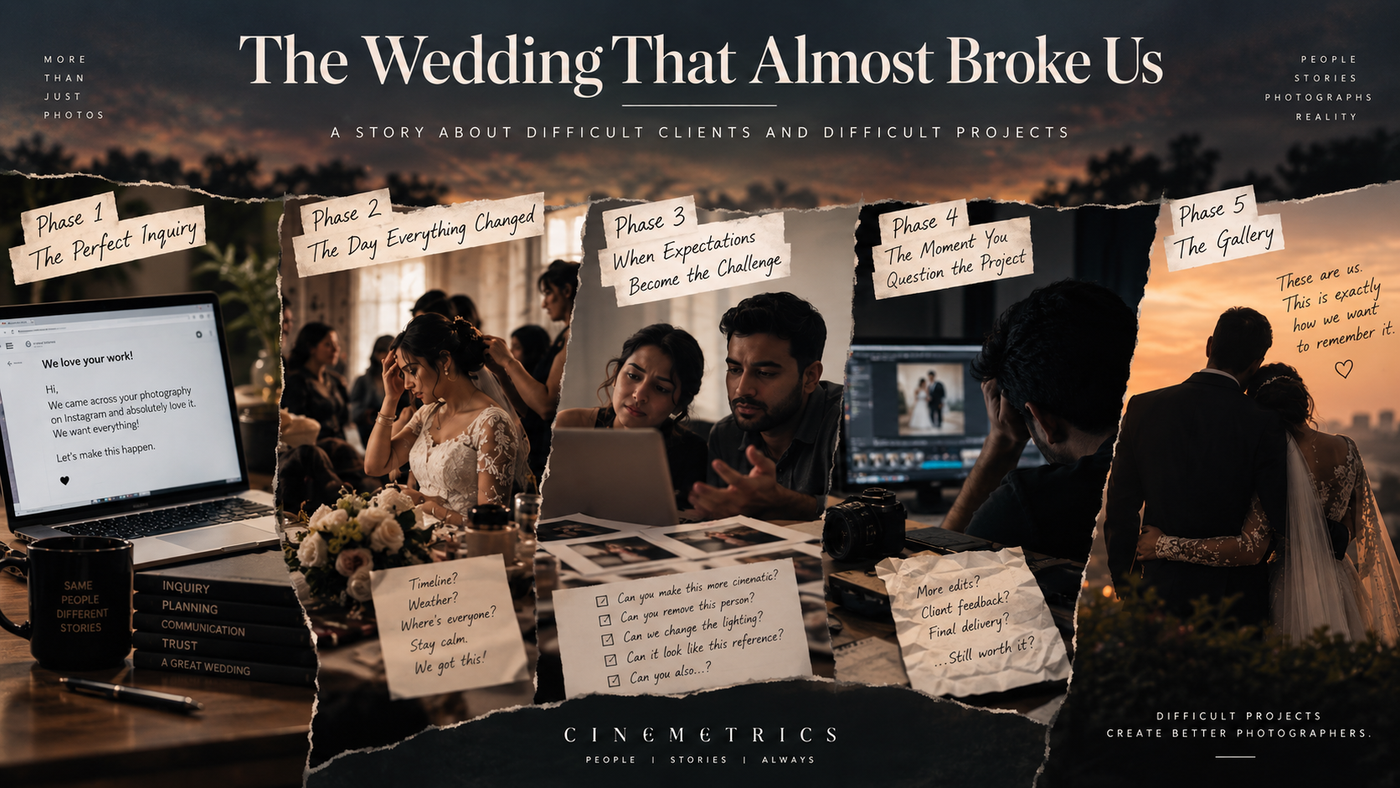
Phase One: The Perfect Inquiry
The first email looked like every photographer's dream. The couple had found our work on Instagram, loved the way we photographed people, and wanted their wedding captured in exactly that emotional, cinematic style. They were excited, responsive and seemingly clear about what they wanted. The budget was good, the venue was beautiful, and the wedding was several months away. There was nothing about the conversation that suggested trouble. If anything, it felt like the kind of project photographers hope lands in their inbox. We had no idea that, six months later, we would be sitting in the editing room at two in the morning wondering how one wedding could possibly have become this complicated.
The first warning sign came quietly. It wasn't an angry email or an unreasonable demand. It was a sentence that sounded harmless: "We've been looking at a lot of wedding photography, and we really want everything." They sent us dozens of reference photographs from different photographers, different countries and completely different lighting conditions. They wanted candid moments, dramatic portraits, editorial photographs, family combinations, details, photographs of every guest, photographs of every event and, somehow, photographs that looked spontaneous while also being perfectly controlled. We could have simply said yes to everything and worried about it later. Instead, we sat down with them and asked what actually mattered. That conversation became the first real test of the project: understanding the difference between what a client asks for and what they are actually trying to achieve.
Phase Two: The Day Everything Changed
Wedding days rarely follow the plan. This one decided to prove the point before breakfast. Hair and makeup was running behind, one family member couldn't be found, the ceremony location changed because of the weather, and suddenly the carefully constructed timeline had collapsed by almost an hour. The couple was getting increasingly anxious because they had imagined their wedding photographs a certain way. We knew something they didn't: the wedding hadn't failed. The plan had failed. Those are two very different things. Our job wasn't to stand there protecting the original schedule. Our job was to rebuild it while everyone else was busy trying to figure out what had gone wrong.
Then came the moment that could have turned the entire day into a disaster. The bride looked at us and said, "We're losing all the photographs we wanted." She wasn't angry. She was genuinely worried. And in that moment, arguing about the schedule would have been the easiest thing in the world. Instead, we took the pressure off her. We explained what we could still capture, what we needed to change and what we would prioritize. We shortened some portions, moved others and quietly communicated with the family so the couple didn't have to manage another problem. The photographs we eventually created weren't the photographs we had originally planned. They were better in one important way: they belonged to that actual day, not to an imaginary version of it.
Phase Three: When Expectations Become the Real Challenge
The difficult part came after the wedding. The couple received their preview gallery and loved many of the photographs, but then the questions started. "Can we make this photograph look more like the reference we sent?" "Can you remove this person?" "Can you change the lighting?" "Can we make this one more cinematic?" None of the requests sounded outrageous individually. But together, they revealed the real problem. They weren't comparing their photographs to what had happened at their wedding anymore. They were comparing them to photographs created under completely different circumstances. Suddenly, we weren't just delivering photographs. We were managing expectations that had been built by years of scrolling through perfectly curated images online.
This is where difficult projects are often won or lost. Not behind the camera, but in the conversation that follows. We could have defensively explained why every request wasn't possible, or we could have disappeared behind the contract and treated the relationship like a transaction. Instead, we walked through the photographs with them. We explained what could be changed, what would look unnatural, and why certain photographs worked precisely because they reflected the reality of their wedding. Some edits were made. Some weren't. More importantly, the couple began to understand the process. We weren't trying to tell them what they should like. We were showing them what was possible while protecting the quality of the work they had hired us to create.
Phase Four: The Moment You Question the Project
There is a point in almost every difficult creative project where the money stops being the first thing you think about. You start thinking about whether the project is worth the stress. This was that point. We had already spent more time communicating, planning and editing than we had expected. Every new message seemed to contain another concern. Even after resolving one issue, another appeared. For a small photography business, that pressure is real. Your time is your product, and difficult projects have a way of quietly consuming it. We had to make a decision: either become frustrated with the clients or become better at managing the project. We chose the second option.
We changed the way we communicated. Instead of responding to every individual request as it arrived, we consolidated the remaining feedback and established a clear path to completion. We stopped treating every problem as an emergency. We started separating genuine issues from preferences. We documented what had been agreed upon and explained what would happen next. Most importantly, we stopped taking the difficult conversations personally. That was probably the biggest lesson of the entire wedding. A client asking for something you can't deliver isn't necessarily disrespecting you. A photographer setting a boundary isn't necessarily being difficult. Sometimes professionalism is simply two people trying to get to the same destination while seeing the road very differently.
Phase Five: The Gallery
Several weeks later, the final gallery was ready. We sent it without knowing exactly what response would come back. Then the message arrived. It wasn't a long email. There were no dramatic apologies or elaborate compliments. It simply said, "These are us. This is exactly how we want to remember it." That sentence stayed with us because the wedding had taught us something that beautiful venues and expensive cameras never could. The hardest part of wedding photography isn't always taking the photograph. Sometimes it is protecting the photograph from everything that happens around it.
Looking back, that wedding wasn't a failure, even though there were moments when it felt like one. It was a difficult project, and difficult projects expose weaknesses that easy ones allow you to ignore. We learned to ask better questions before signing a contract. We learned to identify unrealistic expectations earlier. We learned that timelines need flexibility, that communication needs structure and that boundaries are not the opposite of good customer service. Most importantly, we learned that a wedding photographer isn't simply hired to take pictures. We are hired to manage uncertainty, make decisions under pressure and create something meaningful while the day is constantly changing around us. Sometimes the most valuable photograph is the one you manage to create after everything has gone wrong.